Psychological safety is often misunderstood and undervalued in the workplace. When leaders cultivate a psychologically safe environment, employees become more engaged and are far more likely to propose innovative, transformative ideas.
In one organization, a team member responsible for managing the company’s social media channels experienced recurring challenges linked to psychological safety. Each time a post was shared on the company’s Instagram account, a colleague would respond with sarcasm, eye-rolling, or hypercritical remarks about minor details — from wording choices to selected visuals.
This persistent criticism gradually created anxiety and self-doubt. The employee began questioning the quality of the work, overthinking every post, and trying to anticipate all possible critiques. The fear of making even a small mistake, such as a typo, became paralyzing.
As these micro-critiques accumulated, creativity and risk-taking diminished significantly. The employee felt compelled to play it safe, producing bland and uninspired content solely to avoid judgment. As psychological safety eroded, so did performance and motivation.
What is psychological safety?
Psychological safety refers to the feeling that one can speak up, take risks, and make mistakes without fear of negative consequences.
The concept was introduced by Amy Edmondson, professor at Harvard Business School, who defined it as “a shared belief held by members of a team that the team is safe for interpersonal risk-taking.”
In 1999, Edmondson studied medical teams and discovered that groups reporting more mistakes actually performed better. It was not that they made more errors — but rather, they openly admitted them. Teams with lower reported mistakes were, in reality, hiding them.
Simon Sinek later reinforced the idea in his 2014 book “Leaders Eat Last.” Drawing inspiration from military organizations, he wrote that great leadership makes employees feel safe enough to focus on their mission without fearing for their survival.
Why psychological safety matters
Psychological safety is not a luxury; it is essential for organizational health. Without it, employees lack trust and the entire business suffers.
Julian Lute, senior manager and strategic advisor at Great Place To Work®, explains:
“When people feel psychologically safe — when they can share ideas, questions, and concerns — the company becomes more agile.”
Research from Great Place To Work® shows that employees who constantly question their actions or hesitate to speak up slow down initiatives and hinder progress. A lack of psychological safety can block new projects, new processes, and innovation. Employees may fear being judged, falling behind, or even becoming redundant due to new changes.
Psychological safety allows individuals to show up authentically and bring their full selves to work. It also connects to how organizations support work/life balance.
Julian adds:
“Psychological safety allows people to bring their full selves. The company is looking out for them as more than cogs in a machine.”
Psychological safety vs. psychological health
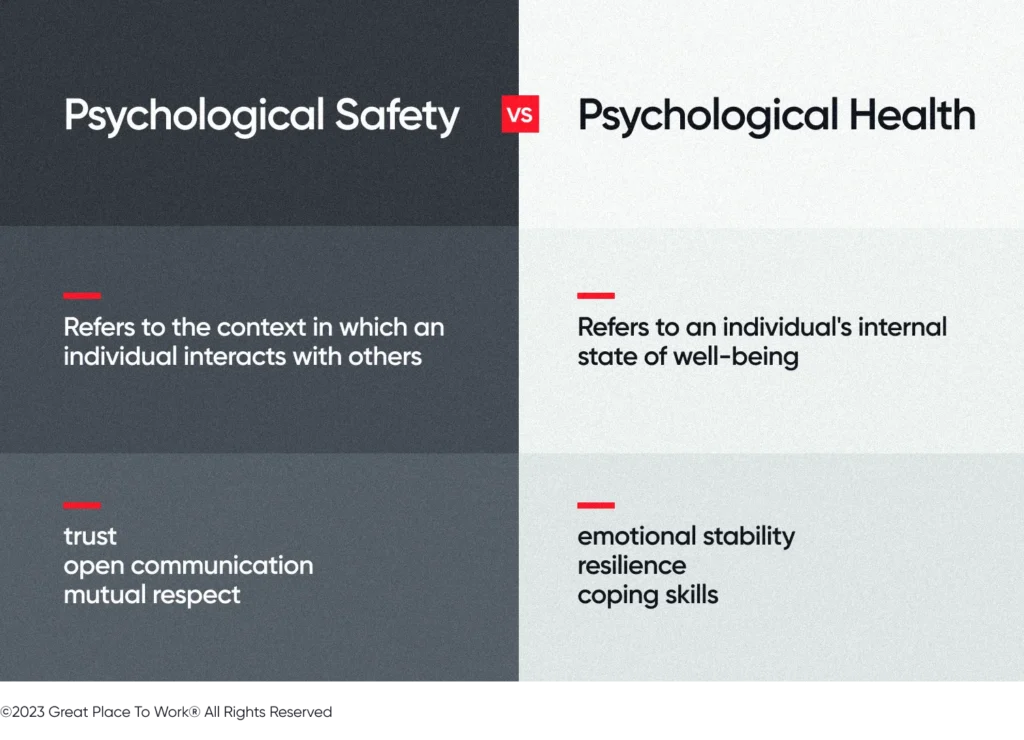
These two concepts are related but distinct. Marcus Erb, vice president of data science & innovation at Great Place To Work, explains that:
- Psychological health refers to an individual’s internal mental well-being — emotional regulation, resilience, self-esteem, and stress management.
- Psychological safety refers to the environment around that individual — the ability to speak up without fear.
A psychologically safe workplace improves psychological health by reducing anxiety and stress. But the two terms are not interchangeable.
6 signs a workplace is psychologically unsafe
Julian highlights several red flags:
Projects take too long to roll out
Employees avoid asking questions or seeking clarity.People don’t ask questions or share ideas
Meetings are silent; ideas flow only top-down.Rumors spread easily
Miscommunication thrives where open dialogue is absent.High absenteeism
People avoid toxic or unsafe environments.High presenteeism
Employees work despite being unwell, or stay hyperconnected digitally to avoid judgment.High turnover
Employees leave for workplaces where their voices matter.
How to foster psychological safety
Dr. Timothy Clark identifies four stages:
- Inclusion safety – Being welcomed authentically
- Learner safety – Freedom to ask and fail
- Contributor safety – Encouragement to share ideas
- Challenger safety – Freedom to question and challenge
Managers can strengthen psychological safety through five key behaviors:
1. Be vulnerable
Leaders who admit gaps or mistakes cultivate trust.
For example, at Ryan LLC, leadership training includes openly sharing stories of failure. This practice encourages transparency and reduces fear among employees.
2. Be transparent
Transparency means sharing:
- what is known,
- what is unknown,
- and how the team will navigate uncertainty.
Consistency between words and actions is essential.
3. Be fair
Fairness in promotions, compensation, and workload reinforces safety.
This is particularly crucial for hybrid teams, where remote workers may feel overlooked due to less physical presence.
4. Be curious
Curiosity-driven leadership questions assumptions and promotes innovation.
SAP America illustrates this through its leadership credo:
“Do what’s right. Make SAP better for generations to come.”
This signals a shift toward trust-based leadership focused on long-term value rather than short-term pressure.
5. Be reasonable
Unrealistic expectations destroy psychological safety.
Hourly workers and global hybrid teams often struggle the most, especially when schedules or time zones undermine work/life balance.
Respecting personal boundaries and trusting employees’ autonomy reinforces a safe, healthy environment.